For years, business leaders have been accustomed to making decisions and delegating their execution. A marketing head approves a campaign. A finance leader reviews an investment. An operations manager identifies a bottleneck. Technology helps teams act on those decisions. But Agentic AI is beginning to challenge this familiar arrangement. What happens when AI systems can independently plan tasks, interact with software, coordinate workflows, and execute actions within defined boundaries? The question is no longer simply how leaders can use AI. It is how they should lead when AI begins to act.
This represents a more consequential shift than the arrival of generative AI tools. While conventional AI assistants largely respond to instructions, agentic systems can pursue objectives through sequences of actions. A customer service agent might retrieve information, assess a request, initiate a resolution, and update records. A procurement agent could compare suppliers, identify anomalies, and recommend purchasing decisions. These possibilities promise greater operational efficiency, but they also introduce a difficult management question: when AI can execute a decision, who remains accountable for its consequences?
The Leadership Challenge Hidden Inside AI Autonomy
For senior leaders, the complexity lies less in understanding the technology than in deciding how much authority to delegate to it. An AI agent might complete a workflow efficiently while overlooking a commercial exception, misinterpreting customer intent, or acting on incomplete information. A process can be technically successful yet commercially damaging.
This creates a new set of everyday leadership responsibilities. Which decisions can agents make independently? When must humans intervene? Who owns an error that travels across interconnected systems? And how should organisations measure performance when speed and efficiency are no longer sufficient indicators of success?
These questions cut across functions. In marketing, autonomous agents could optimise campaigns, but leaders must determine how much freedom they have over budgets and brand communication. In HR, AI-supported workflows may improve responsiveness, but fairness, privacy, and employee trust remain critical. In finance, automated analysis can accelerate decisions, yet accountability for financial exposure cannot simply be transferred to an algorithm.
The challenge becomes even more pronounced with multi-agent systems, where specialised AI agents coordinate to complete complex tasks. Here, governance must extend beyond individual outputs to the interactions between agents, systems, and human decision-makers.
From AI Experiments to Enterprise Operating Models
The next test for organisations is not whether an Agentic AI pilot works. It is whether that pilot can operate reliably within the realities of an enterprise.
Scaling requires leaders to examine workflow design, data quality, cybersecurity, compliance, decision rights, and organisational readiness together. An agent that performs well in a controlled demonstration may encounter exceptions, conflicting instructions, or unreliable information in production.
Consequently, the most valuable leadership capability may be knowing where autonomy creates value and where it introduces unacceptable risk. This demands a shift from tool-led experimentation to outcome-led implementation, supported by clear escalation protocols, human oversight, and measurable business objectives.
It also requires change management. Employees must understand how their responsibilities evolve when AI agents become part of everyday workflows. Successful adoption depends not only on technological sophistication but also on organisational trust and the ability to redesign work thoughtfully.
Preparing Leaders for Decisions That AI Can Execute
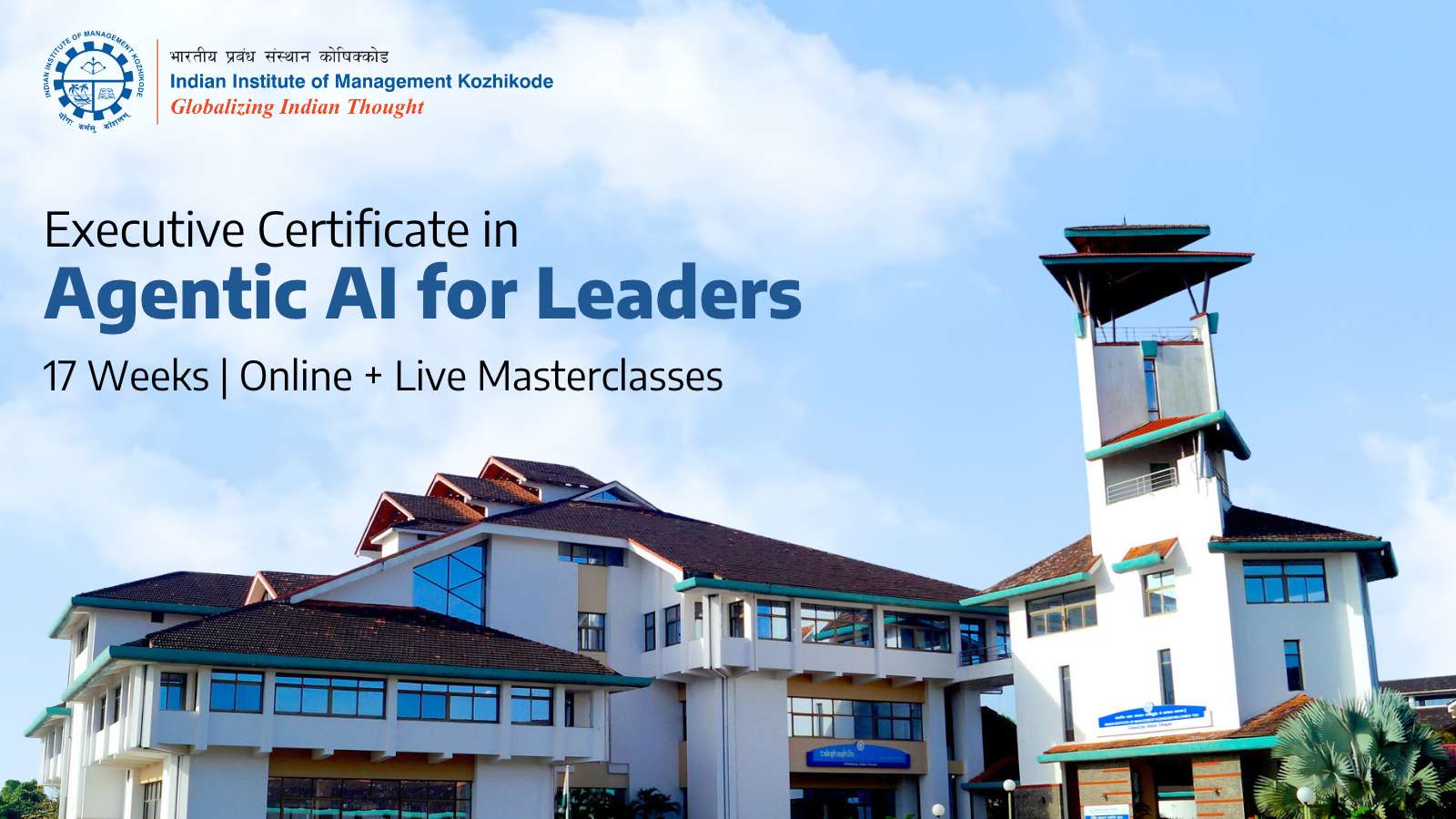
It is this emerging leadership challenge that gives relevance to IIM Kozhikode’s Executive Certificate in Agentic AI for Leaders. Designed for experienced professionals with at least 10 years of work experience, the 17-week programme connects Agentic AI foundations with enterprise workflows, strategic implementation, business value, governance, and organisational change.
Its application-led approach includes four projects based on real-world scenarios, exposure to more than five Agentic AI tools and platforms, and a one-week capstone focused on developing an enterprise transformation blueprint. The learning experience also features four industry expert live masterclasses on leadership with Agentic AI, 16 live doubt-clearing sessions, and an exclusive module by IIM Kozhikode Director Prof. Debashis Chatterjee.
What makes this approach relevant is its emphasis on decisions rather than technology alone. Leaders must learn to evaluate Agentic AI opportunities, distinguish viable applications from unnecessary automation, assess business value, and establish governance before expanding autonomy.
Ultimately, Agentic AI may change how organisations distribute work, authority, and accountability. The leaders who navigate this transition effectively will not necessarily be those who automate the most. They will be those who understand what should be automated, what must remain human-led, and how both can work together to create sustainable business value.
For senior professionals preparing for this shift, exploring IIM Kozhikode’s Executive Certificate in Agentic AI for Leaders offers an opportunity to examine the capabilities required for a future in which leading AI becomes as important as deploying it.