
Key Takeaways — What This Article Covers
- Why India’s growing focus on preventive health is creating sustained demand for nutrition professionals
- What ‘Integrative’ means in practice — and how it differs from conventional dietetics
- The full career landscape: who hires, in what roles, and at what stage of growth
- How the BSc and MSc at LSI World are structured and what sets them apart
- Answers to the most common questions from 12th Science students and parents
Every year, thousands of Maharashtra’s students from science stream choose their career options from MBBS, BDS, Pharmacy, Nursing. These are great in demand careers.
What is less often discussed is that the healthcare system requirement in India is far larger than only these careers. Integrative Nutrition and Dietetics is one of the fastest-growing specialisations.
What is Integrative Nutrition and Dietetics?
Integrative Nutrition and Dietetics is a University of Mumbai-recognised science degree that combines clinical nutrition, lifestyle medicine, and preventive health. Graduates are trained for careers in hospitals, corporate wellness, sports, food industry, and private practice — one of the fastest-growing professional specialisations in India’s expanding health and wellness economy.
India’s National Health Portal, maintained by the Ministry of Health and Family Welfare, lists Nutrition and Dietetics as a recognised career path for Science-stream students, noting that the field is “gaining importance as people have become more conscious about the way they eat” and that qualified professionals can work across hospitals, research, corporate settings, and community health. The Sports Authority of India, a Government of India body, actively recruits MSc-qualified nutritionists for national sports programmes. ICMR — the Indian Council of Medical Research — funds ongoing research in nutrition science and regularly calls for trained professionals.
What Does ‘Integrative’ Actually Mean?
It means treating the whole person — not just the symptom. It means understanding that what we eat, how we sleep, how we move, and how we feel are all connected.
Conventional dietetics focuses on clinical nutrition protocols: disease-specific meal planning, hospital-based dietary management, and therapeutic diets. These are essential skills and remain a core part of the integrative curriculum.
Integrative Nutrition goes further. A conventional approach to, say, a patient managing blood sugar might focus primarily on carbohydrate restriction. An integrative approach asks: What is this person’s sleep quality? Their stress levels? Their physical activity? Their relationship with food? Their gut health? It then designs a personalised protocol that draws on evidence-based clinical nutrition alongside lifestyle medicine, behavioural science, and where appropriate, validated principles from traditional health systems.
This is the model that practitioners like Luke Coutinho have taken to a global audience — consulting with patients across more than 30 countries, advising elite athletes, working with individuals managing chronic and complex conditions, and building one of the largest wellness communities in Asia.
The Fit India Movement — a flagship programme launched by the Prime Minister of India and still actively running — recognised Luke Coutinho as its Lifestyle Ambassador and Champion. This is the professional whose approach forms the philosophical and practical foundation of every LSI programme. Students are not just studying nutrition; they are studying the model that the Government of India has endorsed as its national health vision.
Why the Timing Is Right: India’s Shift Toward Preventive Health
India’s healthcare priorities are shifting. Government programmes, employer investments, and consumer behaviour are all moving in the same direction — toward prevention, toward nutrition, toward lifestyle.
The Government of India’s Economic Survey 2025–26, tabled in Parliament in January 2026, flagged the growing prevalence of lifestyle-related health conditions — driven by changing diets, sedentary work patterns, and urbanisation — as a significant public health priority. It called for stronger investment in nutrition literacy and preventive healthcare.
India’s POSHAN Abhiyaan — the National Nutrition Mission — covers over 7 lakh Anganwadi centres across the country, each requiring trained nutrition professionals to design and evaluate dietary interventions at the community level. (Source: Ministry of Women and Child Development, wcd.nic.in) The India health and wellness food market is growing at a compound annual growth rate of over 18% through 2032, driven by rising consumer demand for functional foods and evidence-based nutrition products. (Source: Data Bridge Market Research, 2024 — databridgemarketresearch.com)
Beyond government, the private sector is moving equally fast. India’s corporate wellness market — which encompasses nutrition counselling, metabolic health programmes, and lifestyle coaching for employees — is valued at over USD 2.6 billion in 2025 and is projected to grow substantially through 2034, according to IMARC Group market research. Companies including large technology firms, banks, and manufacturing companies now run structured employee wellness programmes as a standard benefit. Nutritionists are increasingly core hires for these programmes, not peripheral service providers.
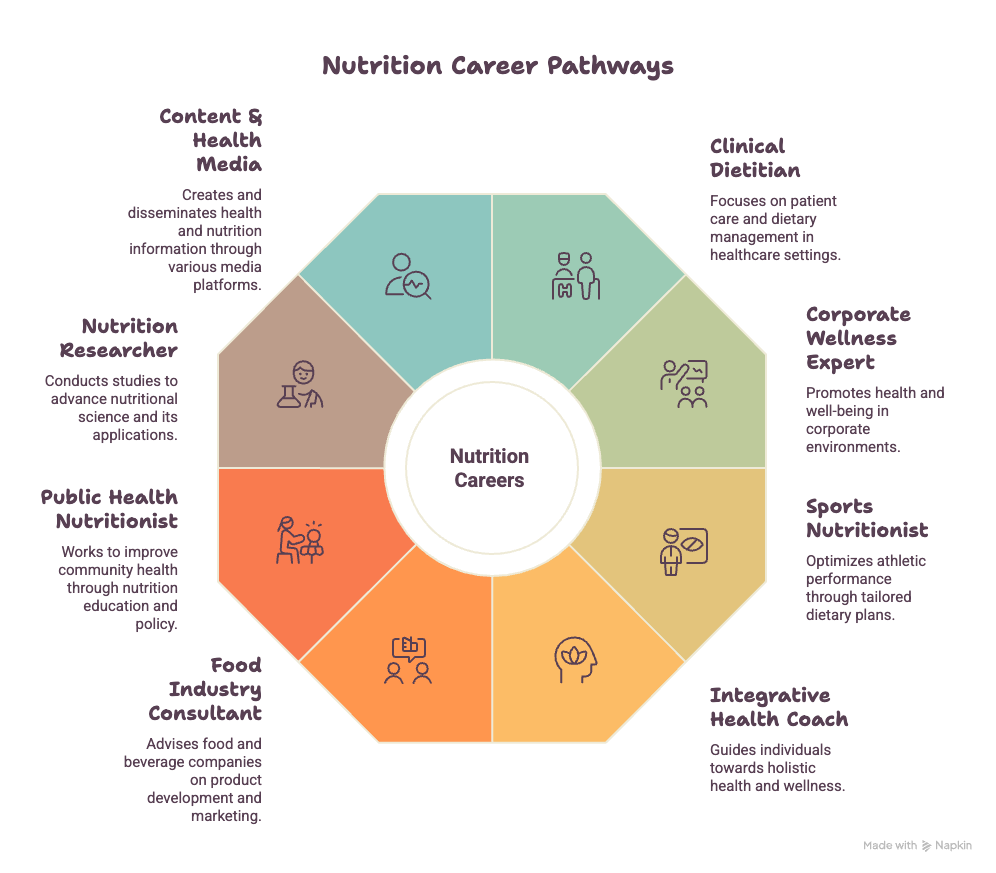
What careers are available in Integrative Nutrition and Dietetics?
Graduates of Integrative Nutrition and Dietetics find roles across hospitals, corporates, sports teams, food industry, public health, and digital platforms.
Integrative nutrition is one of the few health professions where private practice is genuinely accessible early in a career. A graduate with the right specialisation, a credible academic qualification, and a consistent personal presence can build a sustainable client base. The combination of a University of Mumbai degree and LSI ’s practical training provides both the credential and the framework.
Who Is Hiring: A Closer Look
Qualified integrative nutrition professionals are hired across every major sector of India’s economy. Hospitals — from multispecialty units to oncology and metabolic health clinics — remain the largest employer of clinical dietitians, while corporate India is now embedding full-time nutrition professionals into HR and employee wellness teams across technology, banking, and manufacturing firms. The Sports Authority of India formally recruits MSc-qualified nutritionists across its 300+ training centres, and IPL franchises and national academies hire sports nutritionists as first-team staff. In the food and FMCG industry, companies across product development, regulatory compliance, and consumer health communication actively recruit nutrition graduates, offering strong commercial exposure and salary growth. Government bodies including ICMR, FSSAI, WHO India, and UNICEF India provide stable, purpose-driven roles — typically requiring an MSc — with the opportunity to shape nutrition outcomes at population scale. And in digital health, the fastest-growing segment, nutrition apps, telehealth platforms, and wellness content businesses specifically seek University of Mumbai-credentialled professionals to ensure the scientific accuracy that audiences and platforms now demand.
Programmes: What You Study and Where It Takes You
Lifeness Science Institute (LSI) is a Mumbai-based institution in collaboration with Mumbai University affiliated colleges is offering University of Mumbai recognized BSc and MSc programmes in Integrative Nutrition and Dietetics — designed in active collaboration with experts and rooted in the principle that the most effective healthcare is personalised, evidence-based, and lifestyle-centred.
According to the National Health Portal of India — maintained by the Ministry of Health and Family Welfare — employment in nutrition and dietetics is expected to grow at approximately 7% annually, with qualified professionals needed across hospitals, research institutions, corporate settings, and community health programmes. (Source: National Health Portal, nhp.gov.in)
Degree Programmes
- BSc in Integrative Nutrition and Dietetics (3 Years) — University of Mumbai recognised programme
- MSc in Integrative Nutrition and Dietetics (2 Years) — University of Mumbai recognised programme
Eligibility: 12th Standard (HSC) in Science stream
Admissions: Merit-based via University of Mumbai process — no NEET/MHCET score required
Diplomas
- Post Graduate Diploma in Holistic Lifestyle & Wellness Coaching
- Diploma in Health & Integrative Lifestyle
Locations Available at
- MKES Nagindas Khandwala College, Malad (West) – Mumbai
- Ramji Assar Vidyalaya’s Laxmichand Golwala College, Ghatkopar (East) – Mumbai
- B.K. Birla College, Kalyan – Mumbai
The curriculum moves well beyond traditional nutrition science. Students study clinical dietetics and medical nutrition therapy, but also lifestyle medicine, preventive health, gut health and the microbiome, sleep science, stress physiology, and evidence-based integration of traditional health practices. Practical training is embedded throughout. Students graduate equipped for clinical, corporate, research, and independent practice roles.
One of the most distinctive features of student life at LSI is the NutriLounge — a dedicated hands-on learning space where theory becomes practice from the very first semester. Students work in fully equipped food science and chemistry labs, conduct real nutritional assessments, analyse food composition, practise diet planning for clinical conditions, and develop the bench skills that employers in hospitals, wellness centres, and the food industry expect. This is learning that goes well beyond a lecture hall: students have consulted with participants at live wellness events, conducted body composition assessments on athletes at Khelotkarsh, and provided nutrition guidance during professional engagements including Femina Miss India 2026 Maharashtra. Every practical session is designed to replicate the real-world environments graduates will work in.
Integrative Nutrition from Day One — Not Year Three
In many traditional Home Science programmes, the first two years cover a broad general science foundation — shared across streams — before students specialise in nutrition in their final year. At LSI, students study Integrative Nutrition and Dietetics from Day 1, Semester 1. Every module, every practical, every industry interaction is rooted in the specialisation from the moment they enrol. By the time a student completes their first year, they have already begun building the clinical and practical knowledge base that most conventional programmes reserve for their final semester. It is a three-year head start on becoming a practitioner.
Annual Conferences — Designed, Run, and Owned by Students
Every year, BSc and MSc students conceptualise, manage, and execute three landmark health conferences — from agenda design and speaker outreach to logistics, marketing, and live facilitation. Vishwa Swasthyam is LSI’s flagship annual international conference. Past editions have covered cutting-edge themes including integrative strategies for metabolic health, nutrigenomics, and thyroid care. Students liaise directly with Padmashree awardees, international researchers, and senior clinicians — building the professional networks that most graduates spend years trying to access. The 2026 pre-conference session on nutrigenetics saw students facilitate hands-on sessions bridging genetic science with personalised nutrition.
Padmashree Dr. V. Mohan — Diabetologist, Chairman, Dr. Mohan’s Diabetes Specialities Centre; Pioneer in diabetes research said “The LSI programmes are a great practical way of learning”. The keynote address by popular Endocrinologist and Padmashree Dr. Shashank Joshi provided a comprehensive overview of thyroid disorders and emphasised the importance of combining medical, nutritional, and lifestyle interventions. Dr. Yajnik delivered the valedictory address, presenting practical strategies for preventing prediabetes and drawing on his extensive experience in the field. “Modulating the gut microbiota may offer novel strategies for maintaining optimum mental health and preventing and managing prediabetes.” — Dr. Tetyana Rocks, Senior Research Fellow, Deakin University, Australia (VishwaSwasthyam 2024, reported in BioVoiceNews). A post-conference workshop was conducted by RD Dr. Nancy Clark — internationally renowned sports nutritionist — and Dr. Mridula Naik
PaushtiCon is LSI’s annual nutrition and lifestyle symposium, focused on a targeted health theme each year. Previous themes covered topics like bone health for women, with expert-led sessions on calcium science, vitamin D, protein requirements, and lifelong skeletal wellness.
Khelotkarsh is LSI’s international sports conference, where sports science and nutrition science converge. This conference brought together athletes, sports nutrition veterans and mental health researchers. Students conducted live body composition assessments on athletes and attended a T20 cricket match as a capstone learning experience.
You have spent years in the science stream. You understand biology, chemistry, and the fundamentals of how the human body works. That knowledge is the foundation of every nutrition programme. It is not wasted if you do not go to medical college. It is the prerequisite for everything you would study at LSI.
People today need professionals who can sit with them for a full hour, understand their food history, their sleep quality, their stress patterns, their relationship with their body, and then design a plan that actually changes their health trajectory. That is the work of a trained integrative nutritionist. And that work is increasingly valued — in hospitals, in boardrooms, on sports teams, and in the consulting rooms of growing private practices.
If your NEET score opens the door to MBBS, take it if medicine is your calling. If it does not — or if you are looking at MHCET options and wondering whether there is a path that is both scientifically rigorous and genuinely different — this programme exists precisely for you.
The field is growing. The professionals who enter it now, with a University of Mumbai degree and the training philosophy of LSI, are positioned at the beginning of a career that will become one of the defining professional categories of the next decade of Indian healthcare.
Frequently Asked Questions
What is Integrative Nutrition and Dietetics and how is it different from regular nutrition?
Integrative Nutrition and Dietetics combines clinical nutrition science with lifestyle medicine, preventive health, and evidence-based wellness practices. Unlike conventional dietetics — which focuses primarily on clinical meal planning and hospital nutrition — integrative nutrition addresses the whole person: food, sleep, movement, stress, and mindset. Graduates are qualified for all clinical dietitian roles and additionally trained for integrative, corporate, and preventive health careers.
Can I apply for the LSI programmes BSc without NEET or MHCET scores?
Yes. The BSc in Integrative Nutrition and Dietetics at LSI is admitted through University of Mumbai’s merit-based process. Your 12th-grade Science marks (with Physics, Chemistry, and Biology) are the primary eligibility criterion. NEET and MHCET scores are not required. This makes the programme accessible to all science-stream students regardless of entrance exam outcomes. Connect with admissions team on +918645931111 or visit lsiworld.in
Is this a degree or a diploma? Will it be recognised by employers?
It is a full University of Mumbai recognised undergraduate degree (BSc, 3 years) and postgraduate degree (MSc, 2 years). The programmes are offered at MKES Nagindas Kahandwala College (Malad), B. K .Birla College (Kalyan) and RAV’s Laxmichand Golwala College (Ghatkopar).
What kinds of jobs can I get after completing this degree?
Graduates work as clinical dietitians in hospitals and clinics, corporate wellness nutritionists in companies, sports nutritionists for athletic programmes, integrative health coaches in private practice, food industry consultants with FMCG brands, public health nutritionists with government bodies and NGOs, nutrition researchers with institutions like ICMR, and content experts for health platforms and digital media. The career range is broad and continues to grow.
Can I study further after completing the BSc?
Yes. The BSc qualifies students for MSc Integrative Nutrition & Dietetics, as well as for MSc programmes in clinical nutrition, public health nutrition, and food science at other universities across India. MSc graduates can proceed to MPhil, PhD, and research fellowship programmes. ICMR and other government bodies offer funded research positions for qualified nutrition scientists.
Is there demand for nutritionists in government or public sector jobs?
Yes. The Sports Authority of India, ICMR, FSSAI, WHO India, UNICEF India, state public health departments, and programmes like POSHAN Abhiyaan all employ nutrition professionals. Government roles require formal degree qualification, typically an MSc for senior positions. The National Health Portal of India lists Nutrition and Dietetics as an established government-recognised career.
